

© 2026 Made for Planet • Privacy Policy • Terms & Conditions
Platform by Mission Sustainability
By Himanshu Jangid • Nov 22, 2025
And Why It Matters for India’s Future
Introduction
Feeding more than 1.4 billion people while restoring soil, protecting water, rebuilding rural livelihoods, and adapting to climate change is one of India’s greatest challenges. Traditional farming models that focus solely on maximizing yield are increasingly showing limits: depleted soils, stressed groundwater, erratic weather, farmer indebtedness, and declining biodiversity.
Enter sustainable agriculture — a farming approach designed not just to produce food today, but to ensure the land, water, communities and ecosystems can continue producing for tomorrow. According to the Food and Agriculture Organization (FAO), it “must meet the needs of the present generation while ensuring the ability of future generations to meet their own needs, by managing and conserving the natural resource base and orienting technological and institutional change in such a manner that it is technically appropriate, economically viable and socially acceptable.” FAOHome
In this blog you’ll learn:

At its core, sustainable agriculture is about three things simultaneously: environmental health, economic viability, and social equity. FAOHome
A widely-used definition: “Agriculture is sustainable when it is ecologically sound, economically viable, socially just, culturally appropriate and based on a holistic scientific approach.” AgriTech
Breaking it down:
Environmentally sound: soil, water, biodiversity and ecosystem services are maintained or enhanced.
Economically viable: farmers earn a livelihood and the system remains productive into the future.
Socially just: farming supports communities, ensures fair labour, and preserves cultural practices.
According to another FAO summary:
Sustainable food & agriculture (SFA) contributes to the four pillars of food security (availability, access, utilisation, stability) while protecting the natural resource base. FAOHome
So sustainable agriculture isn’t simply “organic farming” or “no‐pesticides”—it’s much broader. It’s a way of designing and running farming systems that can last.
 There are several urgency factors in India:
Large part of Indian agriculture is rain-fed: About 60% of India’s net sown area is rain-fed, and it accounts for ~40% of the country’s food production. nmsa.dac.gov.in
Soil health is under pressure: Indian soil studies show deficiencies in organic carbon and key nutrients, threatening productivity. ScienceDirect
Expanding agriculture is not always viable: Converting more land often means deforestation, ecosystem damage, or unsustainable resource use.
Climate variability & water stress are rising: Sustainable agriculture builds resilience to droughts, floods, and changing patterns.
In short, India’s farming systems need to produce more, use less, and be resilient — and sustainable agriculture is the way.
1. Here are central principles that any sustainable agricultural system must reflect: Enhance productivity, employment & value‐addition Farming should produce enough for food security + decent income, and ideally add value (processing, marketing).
2. Protect and enhance natural resources Soil structure, water availability, biodiversity, genetic resources must be maintained or improved.
3. Improve rural livelihoods & inclusive growth Small and marginal farmers, women and youth must benefit.
4. Improve resilience of people, communities and ecosystems Farming systems must adapt to external shocks (weather, markets).
5. Support effective governance, institutions and policies Enabling policy, collective institutions, farmer organisations and markets must align.
These are drawn from FAO’s sustainable agriculture framework. FAOHome
Here are the kinds of practices that embody sustainability:
a) Soil-health intensive practices
Reduced or no tillage
Use of organic matter (compost, green manure)
Crop rotations and cover crops These practices help restore fertility, increase water-holding capacity, reduce erosion. For example, research shows that in sustainable systems soil organic matter and microbial life are key indicators of long‐term productivity. ResearchGate
b) Water smart & resource efficient farming
Drip/sprinkler irrigation
Rainwater harvesting on farms, pond construction
Scheduling irrigation using soil moisture monitoring These reduce waste, recharge groundwater, and make farming less dependent on unpredictable rainfall.
c) Crop and biodiversity diversification
Mixed cropping, agroforestry, polyculture
Use of locally adapted varieties and crops This increases resilience to pests, diseases and weather shocks.
d) Smarter use of inputs
Integrated Pest Management (IPM) rather than blanket pesticide use
Balanced and site‐specific fertiliser use based on soil testing
Gradual shift to organic or low‐input systems Such measures reduce externalities (pollution, soil degradation) and can lower costs.
e) Climate‐smart, tech‐enabled methods
Climate-resilient crop varieties
Precision agriculture: sensors, AI, monitoring systems
Combining farming with energy (agrivoltaics) or water conservation Sourcing from global analysis: sustainable agriculture now often integrates such technologies. Wikipedia
f) Social & institutional frameworks
Farmer Producer Organisations (FPOs), cooperatives
Fair pricing, access to credit, insurance
Participation of women and youth
Transparent supply chains Without such frameworks, technical practices may struggle to scale.

Here is a side-by-side snapshot:
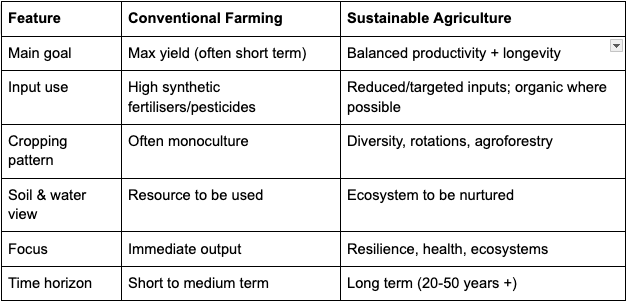
The goal isn’t to demonise conventional farming, but to recognise the shift needed to make agriculture sustainable over decades.
Here are some India-specific figures:
India’s organic farming area (according to the Ministry) is around 2.3 million hectares under certified organic cultivation. nconf.dac.gov.in
A recent study indicates that India has about 1.76 million ha under organic farming, with an additional 3.62 million ha in transition (March 2024). Tropical Agro
Agriculture remains 60% rain-fed, making it vulnerable to hydrological variability. nmsa.dac.gov.in
Soil health: One survey noted ~64% of soil samples low in nitrogen and ~48.5% low in organic carbon. ScienceDirect
While the numbers show positive shifts, they also emphasise the large gap between current practice and ideal sustainable systems.
Transitioning to sustainable agriculture faces several headwinds:
Knowledge and skill gaps in sustainable practices at farmer level
Short-term economic pressures — farmers often need immediate returns
Policy and market misalignment — subsidies still favour high-input methods
Infrastructure gaps for inputs, certification, value-addition
Climate variability — extreme weather events still impose risk
Addressing these requires systemic change as much as individual farm change.
For sustainable agriculture to become mainstream, especially in India, the following elements matter:
1. Policy & institutional support: Subsidies, incentives must align with sustainable practice (e.g., water harvesting, soil health).
2. Farmer capacity building: Training, extension, peer learning, demonstration farms.
3. Market access & value chains: Sustainable produce must fetch fair prices and integrated supply chains.
4. Monitoring and data-systems: Soil health data, water use, yield trends must be tracked to show benefits.
5. Financial instruments: Credit, insurance and risk-sharing tools that recognise sustainable practices.
6. Linkages across sectors: Agriculture + Water + Forests + Livelihoods must integrate (especially in agro-forestry or mixed-ecosystem models).
7. Community & local governance: Smallholder inclusion, women’s groups, local decision-making.
If you’re designing a CSR or agro-forestry project (like afforestation or catchment restoration), always link tree-planting with sustainable agriculture practices — e.g., agroforestry, soil-moisture conservation, farmer training.
Use measurable metrics: area under sustainable practice, soil-organic carbon improvement, water usage reduction, farmer income change.
Tell the story: Show farmers’ voices, community impact, resilience built.
Write for both SEO + AEO: use clear definitions, key numbers, structured sections, FAQs — so your blog appears in search and in AI-based answer engines.
Always include links to authoritative sources (like FAO, government data) to build trust and credibility.
Here are some frequently asked questions about sustainable agriculture:
Q1. Is sustainable agriculture just organic farming? A: No. Organic practices are part of the story, but sustainability also involves economic viability, social fairness, water/soil conservation, and resilience.
Q2. Can sustainable agriculture produce enough food for India’s 1.4 billion population? A: Yes — but only if combined with efficient water use, improved soils, diverse cropping and supported by markets and policy.
Q3. What are fastest-growing sustainable practices in India? A: Natural farming clusters, organic farming transitions, agroforestry, soil health management, water smart systems. For example, 3.62 million ha are reported as transitioning to organic practices. Tropical Agro
Q4. How do we know a farm is sustainable? A: Key indicators: increasing soil organic carbon, declining input costs, stable yield over years, improved water-use efficiency, farmer income up, biodiversity on farm.
Q5. What role can technology play? A: Big role — precision farming, sensors for water/soil, AI for crop/pest prediction, remote sensing for planning. Technology helps scale sustainable practices.
Sustainable agriculture is not simply a “nice-to-have” label — it is an urgent necessity for India’s future. Producing more food, protecting natural resources, securing livelihoods, and adapting to climate change cannot be treated separately. They must be integrated.
Whether you are a farmer, CSR head, NGO practitioner, or writer, the call is clear. Design farming systems that are profitable today, viable tomorrow, and regenerative over decades. Use the data, apply the principles, partner across sectors — and the outcome will be a resilient, food-secure, environment-friendly India.
1. What is sustainable agriculture in simple words?
Sustainable agriculture is farming that produces enough food today while protecting soil, water, biodiversity, and farmer livelihoods so future generations can also farm successfully.
2. How is sustainable agriculture different from conventional farming?
Conventional farming focuses on short-term yield, often using high chemicals and monocultures. Sustainable agriculture focuses on long-term soil health, water efficiency, biodiversity, and stable farmer income.
3. What are the best examples of sustainable agriculture practices?
Examples include crop rotation, agroforestry, drip irrigation, rainwater harvesting, organic manures, cover crops, reduced tillage, and Integrated Pest Management (IPM).
4. Why is sustainable agriculture important for India?
India has 60% rain-fed agriculture and significant soil degradation. Sustainable agriculture helps improve yields, conserve water, increase resilience to climate change, and support farmer livelihoods.
5. Can sustainable agriculture feed India’s population?
Yes. When combined with efficient water use, improved soil health, climate-resilient crops, and better market systems, sustainable agriculture can meet India’s food demand sustainably.
6. What are the major challenges in adopting sustainable agriculture?
Key challenges include lack of awareness, initial transition costs, limited market incentives, policy gaps, climate risks, and inadequate access to training or scientific guidance.
7. What is the role of technology in sustainable agriculture?
Technology helps monitor soil moisture, predict weather, optimize irrigation, detect pests early, and manage farms with precision tools—making sustainable practices more scalable and profitable.
Related topics
Related Categories
Share this blog


